
Criminal Court Cases in Anderson County
Anderson County is part of Tennessee's Seventh Judicial District. Criminal Court is the felony trial venue after indictment or presentment and also handles related post-judgment work. General Sessions Court hears most misdemeanors, issues or receives warrants, conducts initial proceedings, and holds preliminary hearings in felony matters. A person who searches just one division can miss half of the path. The official court information page explains these local roles and identifies the Circuit Court Clerk as custodian for Circuit/Criminal, General Sessions, and Juvenile court records.
Municipal courts in Oak Ridge, Clinton, and Rocky Top keep city ordinance and traffic matters within their authority. They do not hold an Anderson County felony judgment. Juvenile files are restricted under Tennessee law and are not part of routine public inspection. Chancery, Probate, and Child Support records belong to the Clerk and Master, so those counters should not be treated as criminal case sources.
Search Both Anderson County Courts
A felony matter may begin in Anderson County General Sessions with a warrant, complaint, first appearance, bond review, and preliminary hearing. If it is bound over and later charged by indictment or presentment, Criminal Court creates its own case entry. The Sessions number does not have to remain the sole number. Ask the clerk to check both levels by full name and approximate year, then compare charge descriptions, dates, and the arresting agency before deciding two entries describe the same event.
The Circuit Court Clerk page is the official Anderson County access point. It advertises court information and a clerk application, but the inspected public site did not expose a complete anonymous browser search. The official Anderson County court information page is shown in the manifest image below. It supports direct routing without implying that every Anderson County case can be found online.
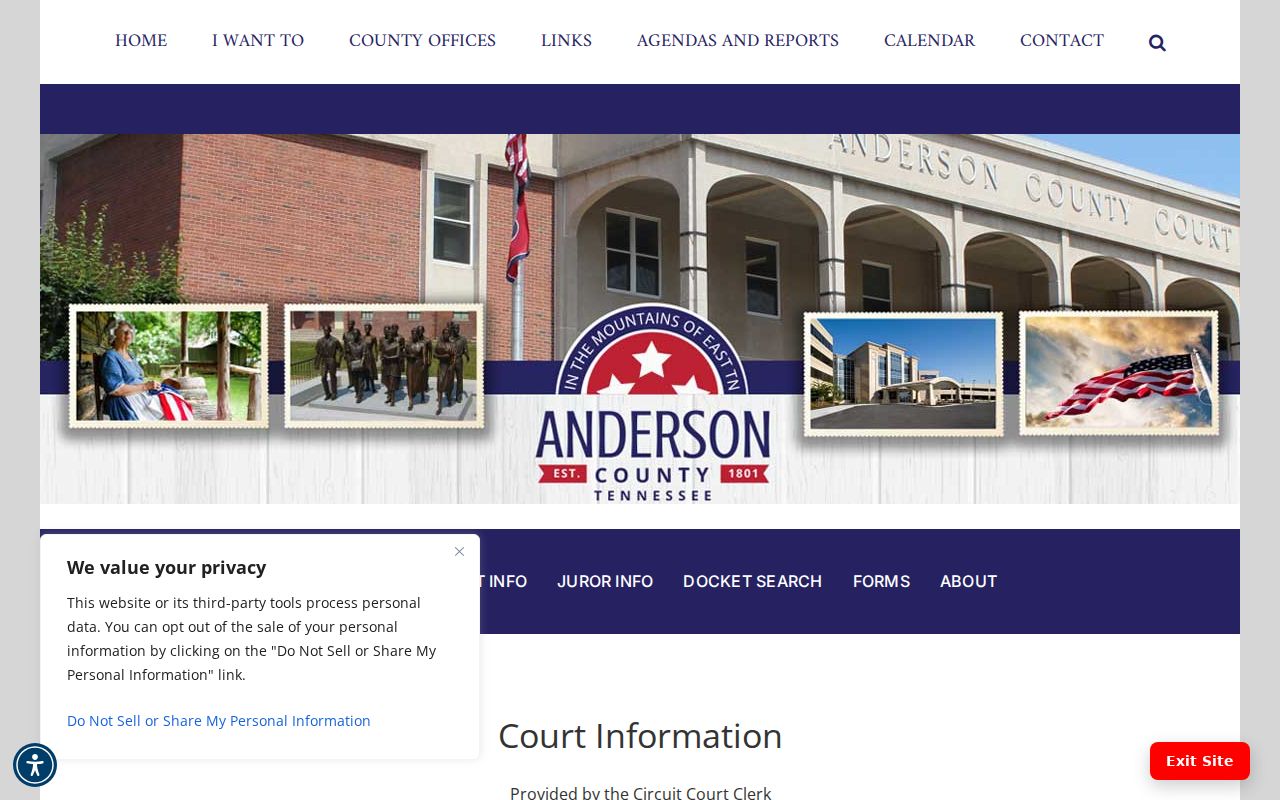
Use the page to confirm Anderson County channels, then call or visit when the local web view does not show the needed case.
Anderson County Case Record Searches
Start with the most precise identifier available. A case number is best, but a full name, name variant, and filing year can support a manual clerk search. Ask for the docket or register of actions, the charging instrument, and the judgment rather than requesting “everything.” For older or non-digitized cases, request counter or archive retrieval. These steps cover Anderson County trial files and the limited statewide appellate layer.
- Identify whether the matter began in General Sessions, Criminal Court, or a municipal court.
- Give the clerk the case number, or provide the full name and approximate filing year.
- Ask staff to search both Sessions and Criminal Court when a felony may have advanced.
- Review the docket, filed charge, judgment, and sentence as separate parts of the file.
- Order a certified judgment when the outcome must be verified, and use appellate case history only if an appeal was filed.
| Search input | Type | Priority | Use |
|---|---|---|---|
| Case number | Text | Best | Direct key for the correct court division |
| Full name | Text | Useful | Check spelling and known name variants |
| Approximate year | Year | Useful | Narrows active and archived entries |
| Court level | Choice | Important | Separate Sessions, Criminal, and municipal files |
| Document sought | Request | Important | Docket, charge, order, judgment, or certified copy |
Request the Full Anderson Case Result
An Anderson County docket is an index of activity. It may show that a motion, plea, order, or judgment was entered without giving the complete text. For a firm Anderson County outcome, request the filed judgment and the sentencing order. When one count changed, ask for the original charging instrument and any amended count as well. Financial fields should be read by label: court costs, fines, restitution, bond, and payments are distinct items, and one figure should not be reported as another.
The Tennessee judiciary's Self-Help Center supplies approved resources for court users. Its manifest image appears below because it represents a valid state support route, not a substitute for the local record. Anderson County copies and certification remain the clerk's work.
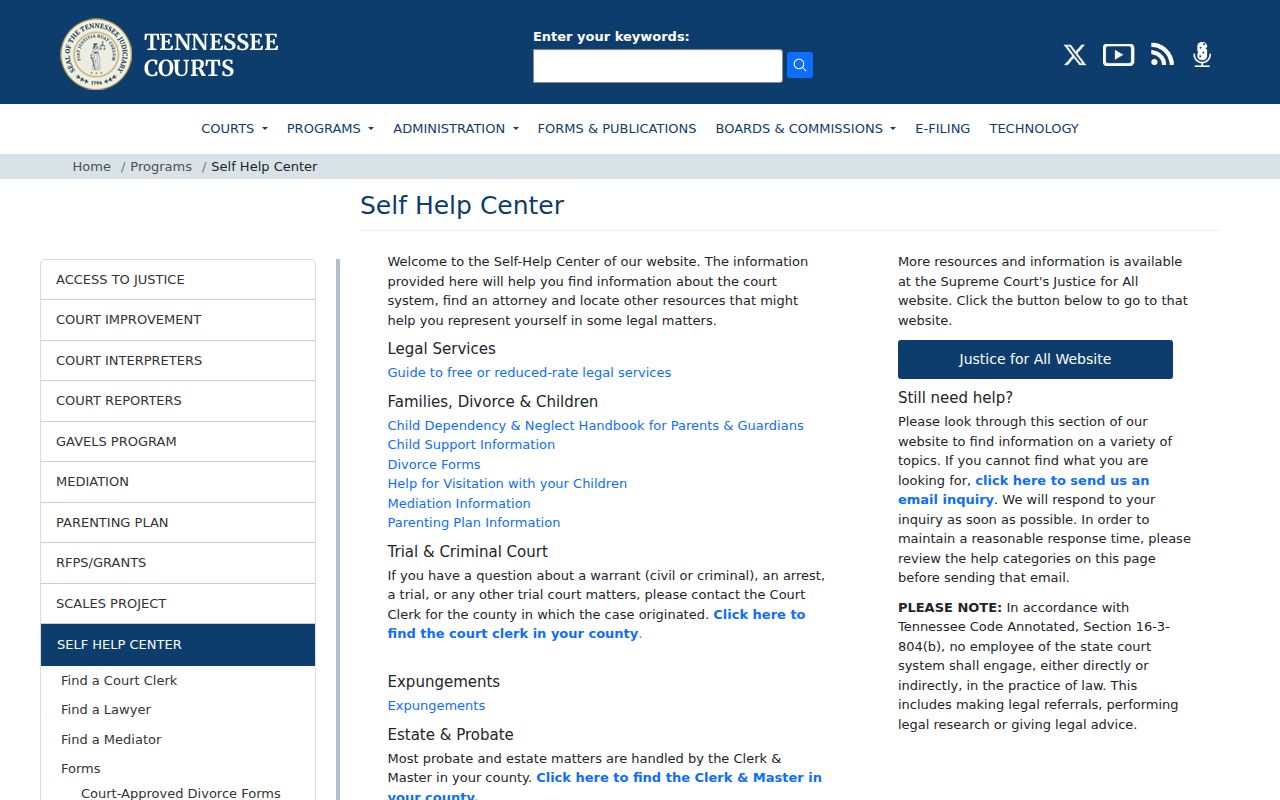
Ask the Anderson County clerk for current copy, certification, retrieval, and delivery costs because the research found no verified criminal-copy fee schedule.
What a Criminal Case File Contains
The Anderson County clerk file tracks the prosecution rather than just the arrest. It identifies the court and parties, records each filed event, and preserves the ruling on each count. A booking record may use the charge known at intake, while the court file can show an amended charge or later indictment. Read each field in context and use the judgment for the final trial-court result.
| Case Number & Court | The file key, division, filing date, case type, status, and assigned judge. |
|---|---|
| Charging Document | The complaint, warrant, information, presentment, or indictment and each charged count. |
| Docket Entries | Filings, appearances, motions, continuances, pleas, trial events, and orders. |
| Hearing Dates | Scheduled and completed settings, including arraignment and sentencing. |
| Disposition & Judgment | Dismissal, nolle prosequi, acquittal, diversion, plea, conviction, or transfer by count. |
| Sentence & Conditions | Confinement, probation, fines, costs, restitution, and other terms recorded by the court. |
Note: A phone summary can aid routing, but a certified Anderson County judgment is the stronger source for a final case outcome.
Bound Over Is Not Convicted
“Bound over” means a General Sessions matter moved toward grand-jury review after the preliminary stage. It does not mean the person was found guilty. An indictment is also an accusation, not proof. The case can later end through dismissal, nolle prosequi, acquittal, diversion, a guilty plea, or a trial conviction. Match the status to the last filed order and read every count because different counts may have different outcomes.
- Nolle prosequi
- The prosecutor formally decides not to continue a charge at that time.
- True bill
- The grand jury approves an indictment.
- No bill
- The grand jury declines an indictment.
- Disposition
- The result of a charge or case.
- Capias
- Court process directing custody, often after a failure to appear or comply.
These Anderson County terms describe steps and results. None should be treated as a conviction unless the judgment records a finding of guilt.
Criminal Case Stages in Anderson County
An Anderson County criminal case does not become a complete public file at once. Police or court process may lead to arrest or citation. General Sessions handles the early warrant, appearance, bond, and preliminary work. A qualifying felony can proceed through grand-jury action and arraignment in Criminal Court. Discovery and motions follow, then a plea or trial, disposition, and sentence. An appeal or later revocation can add more entries.
Case flow: Charges Filed › Arraignment › Pretrial › Plea or Trial › Disposition › Sentencing
Not every case uses each step, and dates vary by the facts and the court calendar. The Tennessee judicial directory for Anderson County identifies the district's court structure. The related manifest image gives useful jurisdiction context.
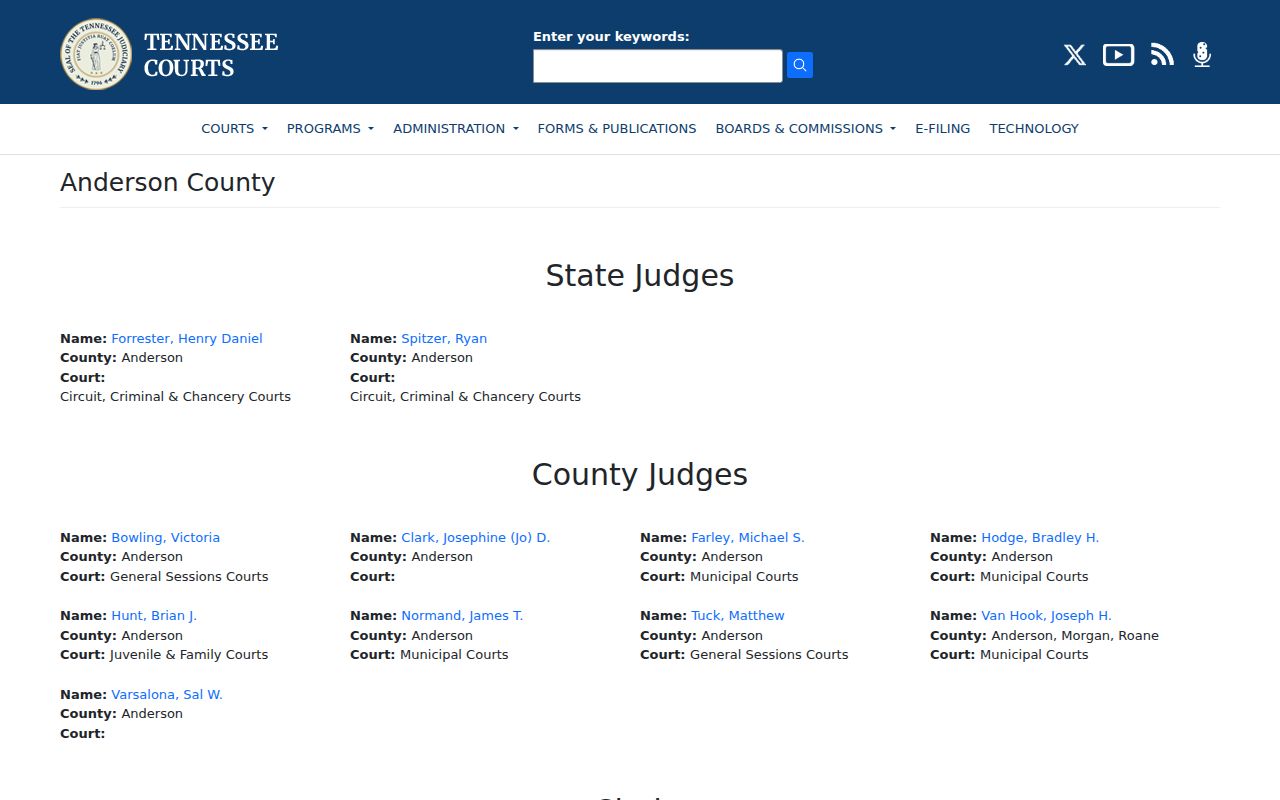
Confirm the assigned division and current setting with the clerk rather than relying on an old calendar or judge listing.
Certified Anderson Judgment or Phone Summary
A clerk's phone response can confirm that a likely file exists, help distinguish Sessions from Criminal Court, and tell a caller how to request it. It is not itself the filed judgment. A certified copy bears the clerk's authentication and is the right document when the exact disposition or sentence must be established. State the case number and the precise document needed so staff can quote the current cost and delivery method.
If an Anderson County case is missing from a limited online view, do not infer that it never existed. Older material may need archive retrieval. Sealed, expunged, and restricted files will not appear like ordinary public records. An appellate search is useful only after an appeal reaches Tennessee's appellate system; it is not a name-search substitute for all local trial dockets.
Municipal and Anderson Criminal Cases Differ
Oak Ridge, Clinton, and Rocky Top municipal courts handle city ordinance and traffic matters within their granted authority. A city citation should be checked with the named municipal court. Anderson County General Sessions and Criminal Court hold the state criminal file. The same event location can therefore determine which clerk has the record, and Oak Ridge's reach into Roane County makes the address especially important.
When an arrest led to county custody, the jail record still does not replace the court file. Booking and release facts belong to the detention facility, while the charge as filed, plea, disposition, and sentence belong to the clerk. Readers tracing the earlier custody step can use the county arrest search routes, then return to the Anderson County case file for the judicial result.
Access Rules for Case Records
The Tennessee Public Records Act, including Tenn. Code Ann. §§ 10-7-503 and 10-7-504, supports citizen inspection of nonexempt records during business hours while preserving confidential material. Anderson County court access does not include sealed or expunged files, ordinary juvenile material, protected victim or minor identifiers, medical information, or data covered by a court order. Redaction can make the public copy narrower than the working court file.
A person seeking their own relief should obtain the Anderson County docket and disposition, use approved judiciary resources, and file in the court that handled the case. Dismissal is a result, while expungement is a separate legal process. Ask the clerk about current requirements and costs rather than applying the published General Sessions civil filing schedule to a criminal record request.